Tuesday, September 8, 2015

Review of Iron Maiden's The Book of Souls

Much has been made about Iron Maiden's decision to make their sixteenth studio effort a double album. The five year gap between this and The Final Frontier along with Bruce Dickinson's recent health scare lead one to theorize that the band felt the need to demonstrate their refusal to back down in the face of old age. On the other hand, over ninety minutes of music gives a lot of fuel for people who believe that the band's "progressive era" has grown more self indulgent with each successive release. The answer seems to be somewhere between these two ideas but The Book Of Souls manages to be an enjoyable listen either way.

For the most part, The Book Of Souls doesn't stray too far from the template that was used on A Matter Of Life And Death and The Final Frontier. The songwriting offers a good deal of variety but still largely matches upbeat tempos and drawn out structures under a darkly introspective umbrella. In an odd twist, Steve Harris's omniscient bass playing might be the least prominent it's ever been and Nicko McBrain's drums play more of a backing role to match. Fortunately, the triple guitar attack rolls with Kevin Shirley's muddy production job well enough and the strength of Bruce's vocal lines make up for any signs of strain.

Going along with that, there do seem to be a few more nods to the band's distant past than usual on here. "Speed Of Light" channels the hard rock grit better than anything on No Prayer For The Dying ever did and the title track is somewhere between "Seventh Son" and "Mother Russia" before hitting "Losfer Words" style speed metal at the halfway point. On the flip side, the intro to "Shadows Of The Valley" may be a little too close to "Wasted Years" for comfort and "The Red And The Black" attempts to match the tone of "Rime Of The Ancient Mariner" but doesn't have enough going on to really justify the thirteen minute running time.

Fortunately, there are still a few curveballs bookending the album that keep things interesting. The synths and spacy vocal effects on "If Eternity Should Fail" make it a slightly jarring opener but the smooth transitions work well and the writing style wouldn't make it too out of place one of Bruce's solo albums. "When The River Runs Deep" uses similarly smooth transitions while the mid-tempo riffs on "Tears Of A Clown" make it one of the band's most straightforward tracks in some time.

And it would be blasphemy to not bring up "Empire Of The Clouds," an eighteen minute epic penned solely by Dickinson. While the lyrics are on an "Alexander The Great" level of dryness and the composition could probably have had a couple minutes trimmed in the middle, the piano driving the piece works quite well and it does have a more cinematic scale compared to many of Maiden's other epics. It's stuff like this and "If Eternity Should Fail" that make me hope Bruce has at least one more solo album left in him...

Even with its more ambitious nature, The Book of Souls just ends up being another good modern day Iron Maiden album. Anyone hailing this one as their best since [insert 80s classic here] hasn't properly acquainted themselves with Brave New World or The X Factor and anyone who says that this is too bloated has probably been saying that about the band in general for nearly a decade. Cutting "The Red And The Black" probably would've made this better than their last couple but not by a drastic amount. At the end of the day, you gotta the band credit for not getting lazy and for aging more gracefully than every other band at their level.

Highlights:
"If Eternity Should Fail"
"Speed Of Light"
"When The River Runs Deep"
"Tears Of A Clown"
"Empire Of The Clouds"

Saturday, August 22, 2015

Review of Sorcerer's In The Shadow Of The Inverted Cross

In a way similar to Hell from the UK, Sweden's Sorcerer is a band that didn't get their due despite releasing a few influential demos back in the day. Original vocalist Anders Engberg and bassist Johnny Hagel reformed the group with new members in 2010 and have finally released their debut studio album a good twenty-seven years after their formation. While I haven't heard their early demos, Sorcerer's debut is packed with new material showing a band that knows what it wants and has the hunger to get it.

Sorcerer plays epic doom not unlike Candlemass or Solitude Aeturnus, but their style is more unique when compared to its peers. The production is cleaner and the aesthetics are still theatrical without going too far over the top. There is also a degree of power metal influence as the guitar tone shows Iron Maiden and Mercyful Fate influence and the vocals opt for a cross between Symphony X's Russell Allen and Harry Conklin's work with Jag Panzer. In a way, the presentation is more polished but the vision itself is more down to earth.
With that in mind, the songs are fairly diverse. Most of them go at a slow building pace but they still find ways to stand out as songs like "Sumerian Script" and "Lake of Lost Souls" feature quiet verses and elaborate structures while others such as the title track put the riffs and soaring vocals on full display. Other tracks such as the faster paced "Exorcise the Demon" and "Gates Of Hell" show off their power metal side quite effectively.

This album is quite solid and the band puts on a good performance, but the actual songwriting isn't quite as memorable as it feels like it should be. The songs are structured well but the rarity of more aggressive riffs or catchy choruses does lead to things running together at times. Fortunately, it all sounds pretty good and "The Dark Tower Of The Sorcerer" in particular has classic potential as it aims to be doom metal's answer to Rainbow's "Stargazer."

With Sorcerer's full-length debut being so overdue, it is a relief to see its few shortcomings having more to do with budding potential than stagnancy. Despite the members' ages, this has the feel of a new band and gets me curious to see how their demos sounded. Hopefully they could make things even more dynamic with a followup effort.

Highlights:
"The Dark Tower Of The Sorcerer"
"Sumerian Script"
"Lake Of Lost Souls"
"In The Shadow Of The Inverted Cross"
"Gates of Hell"

Thursday, August 20, 2015

Review of Weedeater's Goliathan

Weedeater isn't a band that I would call lazy or unsatisfying but it does sometimes feel like they aren't operating at full capacity. They do tour consistently but the full-lengths are always rather short with quite a bit of time between them. The addition of Artimus Pyledriver drummer Travis Owen and a few neat elements help make their fourth album entertaining but things haven't changed all that much in the four years it's been since Jason...The Dragon.

If there's one thing you can say about Weedeater's brand of stoner sludge, it's that they never fail to sound massive even if their songs are rarely more than four or five minutes long. The guitars and drums are always loose and heavy but the group lives and dies by the all encompassing fuzz and forceful shrieks of bassist/vocalist "Dixie" Dave Collins. This is most evident on songs like the building "Bow Down" but he still drives the upbeat "Cain Enabler" and the punky "Bully."

And like Jason...The Dragon before it, there are also moments where the band decides to switch to decidedly non-metal affairs. "Processional" starts the album off with a somber funeral organ and a hatefully whispered vocal while "Benaddiction" ends it with a clean bass demonstration. In addition, "Battered And Fried" sees Dixie swapping the bass out for a banjo and modifying his rasp to a haggard drawl. They pull the switches off better than most of their peers though it'd be interesting to see the styles be integrated even more.
But like the band's other efforts, Goliathan does feel slightly underdeveloped at times. While the songs' brief run times and swelling riffs make their album play out redneck sludge suites of sorts, the ideas always seem like they could be expanded further. The riffs would be even more effective if they were set to coherent structures or even accompanied by the bluegrass instrumentation. But then again, has Weedeater ever been known for complexity?

Overall, Weedeater's fifth full-length is about what you'd expect from them at this point. The elements on here were arguably done better on the last effort but the riffs are great and the variety is enjoyable even if it is too short. It's the sort of sludge that demands to be played live and I'll be looking forward to hearing it next time they come to town.

Highlights:
"Processional"
"Cain Enabler"
"Bow Down"
"Claw of the Sloth"

Thursday, August 6, 2015

Review of Steven Wilson's Hand. Cannot. Erase.

The success of Steven Wilson's solo career has eased the pain of life without Porcupine Tree. Albums like Grace for Drowning and The Raven That Refused to Sing (And Other Stories) are some of the strongest and most ambitious that contemporary prog has to offer but something has been missing despite or perhaps because of their complexity. Now with the release of his fourth full-length solo effort, Steven Wilson has reached a compromise of sorts that combines the best elements of the various projects that have defined his long running career.

While Hand. Cannot. Erase. isn't exactly a back to the roots album, it is certainly Wilson's most accessible as a solo artist since he debuted Insurgentes in 2008. The tone isn't as murky as the last couple efforts, the jazz influences have largely been pulled back in favor of more flamboyant keyboard and guitar flourishes, and the longest and most elaborate songs are full of memorable melodies. There are also a few unique elements as industrial influences pop up for the first time in a while and vocals by Israeli pop singer Ninet Tayeb appear on tracks such as "Perfect Life" and "Routine" to give the album's concept more credibility.
Speaking of which, the inspiration taken from the life and death of Joyce Carol Vincent does make this album's concept slightly creepy but you won't find too many Raven style ghost stories here. Instead, the theme is more nostalgic and its theme of family and growing up give it more in common with In Absentia or Fear Of A Blank Planet than anything else.

It also helps that the songwriting and vocal lines on this album are catchy as hell. The title track provides the most straightforward example of this with its peppy progression but even the longer songs have distinct lines amidst the tangents with "3 Years Older" in particular offering a gentle refrain after moving away from its "2112" style overture. Wilson's talent for hooks and vocal layering never truly went away but seeing it highlighted on here like this makes one realize how much it's been missed the days of The Incident.

Much like the recent incarnation of Swans, the epic scope of Steven Wilson's solo material combined with the fast rates of its release sometimes lead me to question its quality along with the man's sanity. Fortunately, I love to be proven wrong as Hand. Cannot. Erase. is not only his best solo album but just might be one of the best he's recorded with any group. The structures are as tricky as ever but the changes in tone make it a comforting listen for old fans and new listeners like. Highly recommended to prog fans everywhere.

Highlights:
"3 Years Older"
"Hand Cannot Erase"
"Routine"
"Home Invasion"
"Transience"

Monday, August 3, 2015

Review of Crypt Sermon's Out Of The Garden

Doom metal still isn't likely to become a commercial juggernaut anytime soon but it has certainly become more prominent in recent years. The emphasis on slower tempos and riff-driven songwriting seem to appeal to music lovers both in and out of the metal community, but there are plenty of people who tire of the numerous Sleep and Electric Wizard clones shambling about. Philadelphia's own Crypt Sermon has its share of throwback elements but opts for a path less traveled on their full-length debut.

It is obvious from the get go that Crypt Sermon owes a huge debt to Candlemass but it is rather surreal to see how far they go to capture the elements of their idol's classic era. The vocals have more in common with Robert Lowe than Messiah Marcolin but the production similarly muffles the guitars and drums, slow riffs and sprawling choruses dominate throughout, speedy segments pop up on "Heavy Riders" and "Into The Holy of Holies," and even the cover painting looks like it could've been in the same series as the works that appeared on Nightfall through Tales of Creation.

The style is pulled off well but there are a few points that could be expanded with future efforts. Candlemass only had a handful of good production jobs over the course of their career and the muffled production doesn't do this band too many favors either. The vocals have a tendency of getting obscured and it's hard to tell if they need to be more operatic or just need to be brought out with a stronger mix.
Fortunately, the songwriting more than overcomes these minor flaws and clearly states why the Pennsylvania group deserves to be mentioned in the same breath as their Swedish predecessors. The opening "Temple Doors" sets the stage well with its foreboding atmosphere and the loose feel on "The Will of the Ancient Call" make it about as memorable. From there, the lyrics on "The Master's Bouquet" are a bit silly but the catchy vocal lines during the verses make it another worthy highlight.

Overall, Crypt Sermon's debut has an excellent eye for detail and the solid songs keep their heads above the tides of the contemporary doom scene. While some may be turned off by the production and reliance on that beloved Candlemass influence, their classy execution puts them well above most of their peers. One can hope that their future efforts will be presented in an even stronger fashion.

Highlights:
"Heavy Riders"
"The Will of the Ancient Call"
'Into the Holy of Holies"
"The Master's Bouquet"

Saturday, August 1, 2015

Review of The Mountain Goats' Beat The Champ

It's been three years since the Mountain Goats released Transcendental Youth in 2012. Such a time is typical for most groups in this era but it's practically an eternity for John Darnielle's insanely prolific indie folk entity. The band was touring at least and Darnielle dabbled in the world of fiction once more with 2014's Wolf In White Van. Now in 2015, the Mountain Goats are back to apply their signature quirks to the odd world of underground professional wrestling.

I'll admit to thinking it was a joke when Beat The Champ's theme was announced, but there's no denying that it's just another that the band manages to make relatable. They've incorporated religion, literature, nerd culture, and historical anecdotes into their past musings so it isn't too shocking to see sweaty guys (mostly) pretending to beat each other up be treated with the same dignity. Points of view alternate between the wrestler, spectator, and the omniscient while the moods are somber, humorous, somber, and nostalgic when they aren't any sort of combination.

The instrumentation also manages to keep things interesting. The piano and woodwinds that drive the opening "Southwestern Territory" gives it an encompassing feel that could make a neat sports montage,  "Choked Out" has a heavy punk style, and the double bass percussion on "Werewolf Gimmick" gives further credibility to Darnielle's love for extreme heavy metal.
But for everything this album has going for it, it doesn't quite hit the same emotional depths as the Mountain Goats' past work. The theme of childhood nostalgia on "The Ballad of Chavo Guerrero" makes it feel like a companion piece to The Sunset Tree right down to the stepfather quip and the humorous refrain on "Foreign Object" aims to serve as another shout-along in the vein of "No Children" and "This Year," but neither attempt is quite as powerful. Some may point to the theme as being responsible for this but it may just come down to the fact that Tallahassee and The Sunset Tree are just that hard to top or even match.

Overall, Beat the Champ may not be another essential Mountain Goats album but its experiments and overall quality keep it from sounding complacent. The wrestling themes would've failed in lesser hands (I'm honestly surprised some nu metal band or horrorcore rapper didn't beat them to it) but the subject is done justice. I don't see this capturing that demographic but it's a safe purchase for fans and worth checking out once you've heard their more seminal efforts.

Highlights:
"The Legend of Chavo Guerrero"
"Foreign Object"
"Heel Turn 2"
"Stabbed to Death Outside San Juan"
"Werewolf Gimmick"

Tuesday, July 28, 2015

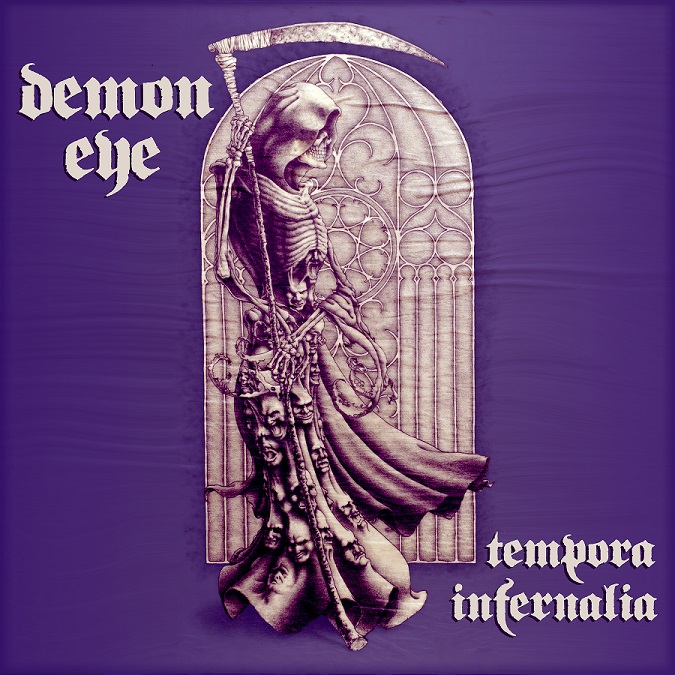
Review of Demon Eye's Tempora Infernalia

There are some things in life that are either so inherently likable or just so easy to pull off that it's really hard to screw them up. Along with such life staples as pizza and sex, any band playing 70s style riff rock seems to be set for instant likability no matter how plain the presentation may be. North Carolina's Demon Eye could get away with this given their choice of genre but they really manage to go above and beyond for their second full-length album.

While Demon Eye is gritty enough for them to be associated with the stoner doom community, you won't find too many slow tempos or downtrodden riffs on here. Instead, the band pulls influence from several different bands; the intricate guitar work is somewhere between Rush's first three albums and Iron Maiden's first two, the nasally vocals remind one of a lower pitched Geddy Lee, and the songwriting has the same shuffle that defined the early efforts of Rainbow and Deep Purple.
The songs themselves don't stray too far from the upbeat swing tempos but there are some that break the mold. "Listen To The Darkness" and "Black Winds" opt for fast paced stoner rock, "Give Up The Ghost" combines a mid-tempo with a neat Eastern vocal/guitar harmony, and "Poison Garden" and "Please, Father" take things into spacier directions. Of course, the upbeat songs end up being the best with "I'll Be Creeping" and "See The Signs" in particular throwing out hook after hook.

Demon Eye's second album has no aspirations of genre revolution or any epic scope, but the fun factor makes it one of the strongest albums 2015 has to offer. The songwriting shows a lot of skill and care behind it and the band's energy matches it in spades. I have yet to hear their debut in full but I just may have to look into it as I wait for even greater things in the future.

Highlights:
"End Of Days"
"I'll Be Creeping"
"See The Signs"
"In The World, Not Of It"
"Black Winds"